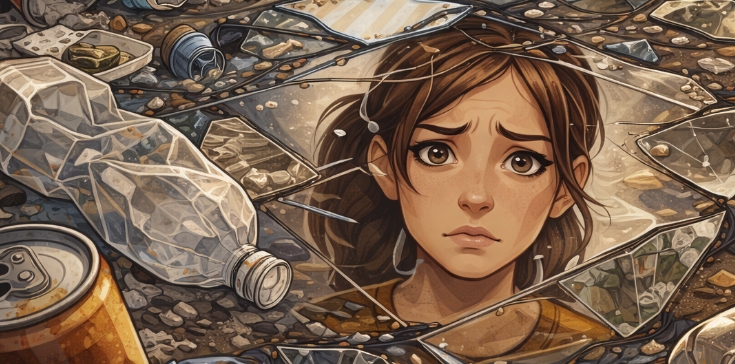
Every time I pass a pile of trash on the roadside, one sentence echoes in my mind. My late mentor, Professor Enri Damanhuri, once said, "Waste is not a technical problem; it is a problem of character". That sentence makes me feel as though I am looking into a mirror. Those heaps are no longer just filth; they are the most honest portrait of our civilization. Waste never lies; it records exactly what we consume and what we squander, while the earth patiently accommodates it all. Today, that mirror shows us that we are slowly drowning. Our habit of hoarding, discarding, and forgetting has shaped how we view public spaces, including our rivers, which have been transformed from the cradles of civilization into victims of indifference.
The Irony of an Indifferent, "Rich" Nation
Indonesia is known as a land of abundant resources, yet behind this wealth lies a great irony: we do not know how to value what we have. We buy more than we need, hoard food until it rots, and discard it without a trace of guilt.
According to 2024 SIPSN KLHK data, Indonesia generates over 36 million tons of waste annually, with 67.29% remaining poorly managed. Ironically, 38% of this waste is food scraps, enough to feed 60 million people and potentially eradicate hunger in the country. These figures are not just statistics; they are a portrait of collective extravagance. We fear scarcity, yet we are not ashamed to waste.
Environmental education has been taught since elementary school, but behavior remains stagnant. Perhaps this is because we are conditioned to theorize about nature without ever being taught to truly love it. This wastefulness extends beyond the kitchen; it is reflected in how we treat our living spaces. We aren't just throwing away food; we are throwing away our connection to the very environment that sustains us.
Turning Our Backs on Civilization
The great civilizations of the Indonesian archipelago were born on riverbanks: Kutai on the Mahakam, Sriwijaya on the Musi, and Majapahit on the Brantas. Rivers were once the face of civilization, a source of life and spirituality.
Today, however, our homes literally turn their backs on the water. We have relegated rivers to the "backyard," treating them as dumping grounds rather than life sources. According to BPS (2020), 46% of Indonesia’s 70,000 rivers are heavily polluted. Even our language has shifted: the word for "back" (Belakang) in a household context is now synonymous with trash and toilets. When we stop respecting our rivers, we stop respecting life itself.
The Vicious Cycle and Ecological Heartbreak
The waste problem persists because we are trapped in a cycle of old habits: a reluctance to sort and a resistance to change. Most Indonesian waste is wet organic matter, which can be easily managed through composting, biogas, or maggot cultivation. But when mixed with plastics and inorganic materials, it all becomes a foul-smelling mass that is difficult to process.
Even more disheartening are the citizens who do try to sort their waste, only to have their spirits crushed when they see the collection trucks arrive and mix it all back together. This isn't just a technical failure; it is an ecological heartbreak.
Data shows that only 11% of Indonesian households consistently sort their waste. Out of 36.5 million tons of national waste, approximately 24.5 million tons (67%) end up in landfills or wash away into the sea. Weak systems have eroded public trust, and environmental management budgets in many regions remain below 3% of the local government budget. We are still clinging to the outdated paradigm of "Economy over Environment," forgetting that without a healthy planet, economic growth can never be sustainable.
When Waste is Called "Energy"
Amidst this exhaustion, a major initiative has emerged from Danantara through the PSEL program (Waste-to-Electrical Energy). The government and private partners are targeting the development of PSEL facilities in ten major cities, an ambitious step in national waste policy.
While the spirit of turning waste into a resource is commendable, we must remain clear-headed: is the nation ready?. We must be honest about the fact that the majority of our waste has high moisture content and low caloric value. Burning it requires massive energy and high costs. If the upstream process remains chaotic, even the most advanced incinerator will simply be an "expensive machine" providing a temporary fix.
In the hierarchy of waste management, energy recovery sits near the bottom, just one step above final disposal. Technology, no matter how sophisticated, remains curative rather than preventive. We must ensure this initiative doesn't just modernize the old "collect-transport-dump" pattern at a much higher price. Waste should be resolved as close to the source as possible, in homes and villages, not just burned at the edge of a metropolis.
A Generational Shift
The long-term solution lies not in machines, but in humans. We may need “generational cut", much like the Shin Tae Yong’s strategy used to rebuild national soccer teams to instill new character from an early age. We must learn that loving the environment is a matter of national dignity. Furthermore, we must change how we view sanitation workers. They are not "low-level" laborers; they are the heroes of our cities. When sanitation workers in Paris went on strike in 2023, the city was paralyzed. It proved that without them, even the most modern city collapses.
Staring into the Mirror
Great change does not happen overnight. But every small step, sorting at home, respecting cleaners, refusing to litter, is a tangible act of love for this country. A great nation is perhaps not one without waste, but one that is brave enough to learn from its own refuse.
Waste is not our enemy; it is the mirror that shows us who we truly are. We can build the most advanced incinerators and sign grand agreements, but it will all be in vain if our mindset remains unchanged. Before we get busy converting waste into energy, it is time we first convert the "waste" within our own way of thinking.
Belum ada komentar. Jadilah yang pertama berkomentar!