
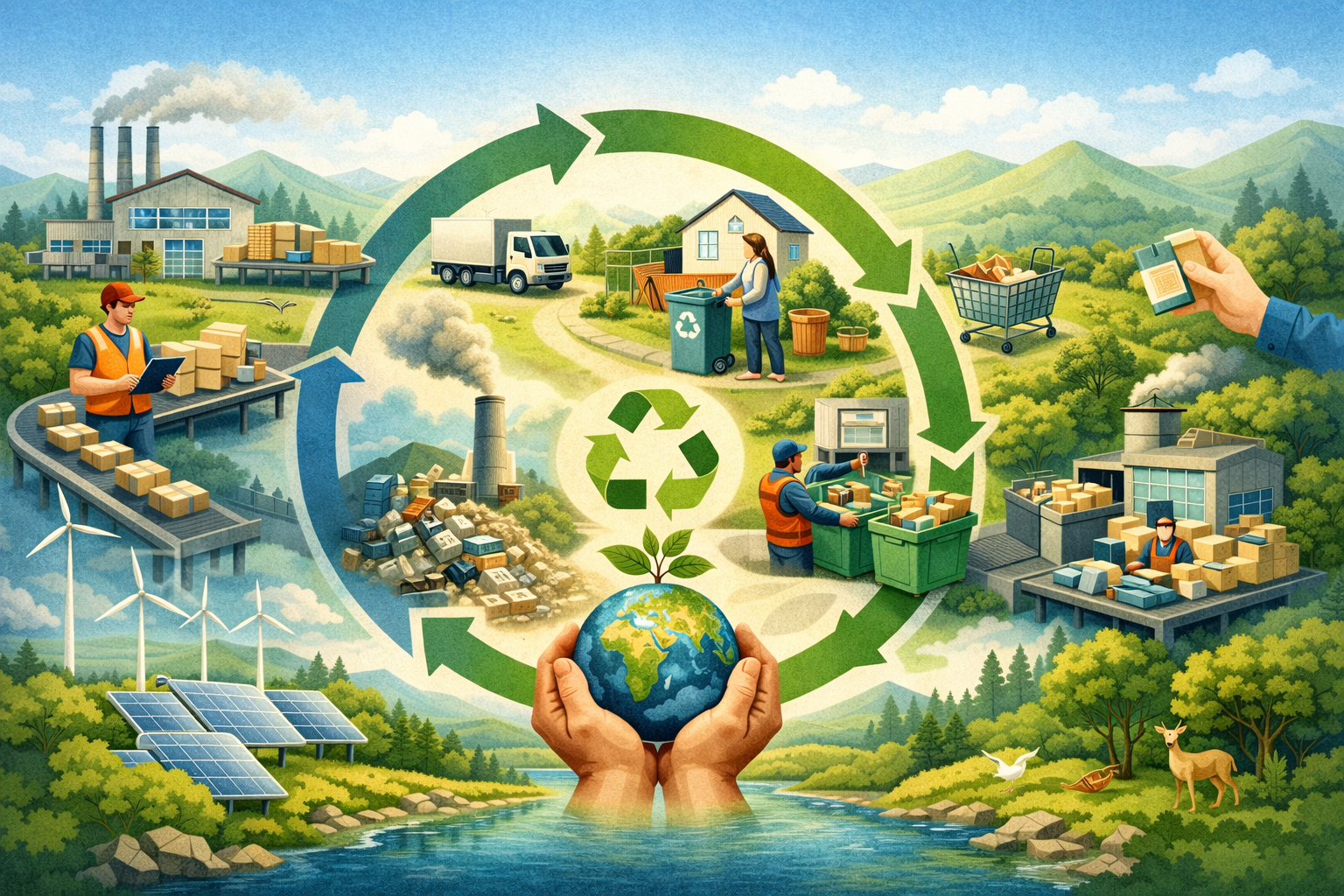
Extended Producer Responsibility (EPR) is a key policy instrument within sustainable development frameworks, designed to respond to the escalating environmental pressures arising from modern patterns of production, consumption, and waste generation. Grounded in the principle that producers should be accountable for the environmental impacts of their products throughout the entire life cycle, EPR reallocates responsibility for waste management from public authorities and taxpayers to producers and importers. Over recent decades, this approach has demonstrated considerable effectiveness in advancing environmental sustainability by encouraging waste minimization, enhancing resource efficiency, and fostering more sustainable production systems.
At its core, EPR expands producer obligations beyond the point of sale to include post-consumer stages such as product collection, recycling, and final disposal. By doing so, it incentivizes manufacturers to integrate environmental considerations into product design, material selection, and packaging practices, thereby supporting the development of more sustainable and circular product life cycles.
One of the most significant contributions of Extended Producer Responsibility to environmental sustainability lies in its capacity to reduce waste generation and improve recycling rates. EPR schemes targeting products such as packaging, electronic equipment, batteries, and tires have been widely adopted across Europe, parts of Asia, and increasingly within developing economies. These programs typically establish collection targets, recycling obligations, and reporting requirements, resulting in substantial volumes of waste being diverted from landfills and the natural environment into regulated recycling systems. Consequently, EPR not only mitigates land and marine pollution but also contributes to the reduction of greenhouse gas emissions associated with waste disposal and incineration.
EPR also plays a crucial role in promoting eco-friendly design and innovation. When manufacturers are financially or physically responsible for managing their products at the end of their life, they have a clear incentive to design products that are easier to disassemble, reuse, and recycle. This has led to reduced use of hazardous substances, lighter packaging, modular product designs, and greater use of recycled materials. In this way, EPR aligns with the principles of a circular economy, where materials are retained for as long as possible and waste is minimized. Environmental sustainability benefits directly from reduced resource extraction, lower energy consumption, and reduced ecological degradation.
Another important contribution is the role EPR plays in conserving natural resources. By increasing recycling and material recovery, EPR reduces reliance on raw materials such as metals, plastics, and paper. The extraction and processing of these materials is often associated with deforestation, habitat destruction, water pollution, and high carbon emissions. Recycling materials typically requires significantly less energy than producing them from raw resources. Thus, EPR indirectly supports climate change mitigation and biodiversity protection by reducing pressure on natural ecosystems.
From a governance perspective, EPR strengthens environmental accountability and shared responsibility. It clarifies the roles of producers, consumers, and governments in achieving environmental goals. Governments establish regulatory frameworks and targets, producers organize or finance compliance systems, and consumers participate through appropriate waste separation and return schemes. This shared responsibility model raises environmental awareness across society and encourages behavioral change. Consumers become more aware of the environmental impact of their purchasing decisions, while producers integrate sustainability into their corporate strategies rather than treating it as an external obligation.
Despite its numerous advantages, the effectiveness of Extended Producer Responsibility is highly dependent on robust policy design and rigorous enforcement mechanisms. Inadequately structured schemes may result in operational inefficiencies, funding shortfalls, or limited environmental gains. Conversely, when carefully designed and effectively implemented, EPR has demonstrated considerable adaptability to diverse local conditions and the capacity to evolve over time. Contemporary EPR frameworks increasingly integrate digital monitoring systems, eco-modulated fee structures based on environmental performance, and stronger alignment with circular economy objectives. These innovations further strengthen EPR’s role in advancing environmental sustainability.
By transferring responsibility upstream within the production chain, EPR encourages environmentally responsible product design, enhances waste management performance, promotes the conservation of natural resources, and mitigates pollution. Its close alignment with circular economy principles underscores its relevance in addressing global challenges such as resource depletion, climate change, and the rapid growth of waste streams. Although implementation and enforcement challenges persist, the overall contribution of Extended Producer Responsibility to environmental sustainability remains significant and well substantiated.
Belum ada komentar. Jadilah yang pertama berkomentar!