
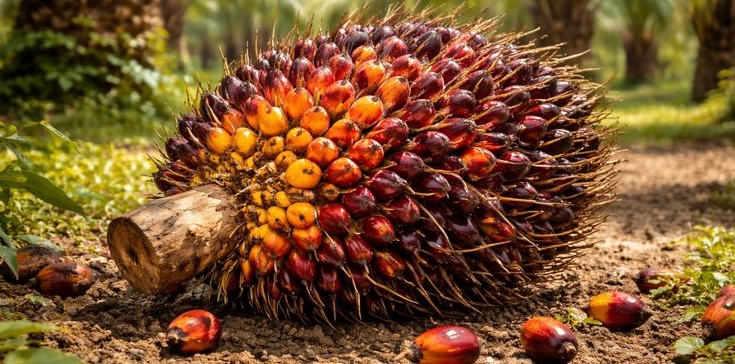
Indonesia is the world’s largest producer of palm oil, contributing more than 50% of global palm oil production. In 2024, Indonesia’s palm oil production reached 45.44 million tons, representing a slight decline compared to 47.08 million tons in 2023 [1]. As a by-product of palm oil production, oil palm empty fruit bunches (OPEFB) are generated, which contain fibers with lengths ranging from 0.78 to 1.81 mm and is classified as short- to medium-length fibers [2].
From the processing of fresh fruit bunches, approximately 21–23% is converted into oil palm empty fruit bunches, a proportion that is nearly comparable to the amount of crude palm oil produced, which is around 24% [2]. Based on palm oil production in 2024, it is estimated that approximately 39.8–43.6 million tons of oil palm empty fruit bunches were generated during that year. To date, the utilization of oil palm empty fruit bunches remains suboptimal. They are commonly incinerated at palm oil mills, applied as mulch in oil palm plantations, or processed into compost fertilizer [3]. However, research conducted at both laboratory and industrial scales has demonstrated that fibers derived from oil palm empty fruit bunches have significant potential as raw materials for paper production, particularly for packaging paper, which currently relies heavily on recycled fibers [2].
On the other hand, there are more than 23 paper mills in Indonesia that rely on recycled paper as their primary raw material, sourced from both domestic and imported waste paper. It is estimated that Indonesia requires approximately 7 million tons of waste paper annually. In 2023, about 3.24 million tons of this demand was met through imports, some of which originated from European Union countries [4]. European Union regulations governing the shipment of waste paper classified as non-hazardous waste are scheduled to take effect on 21 May 2027. In anticipation of this development, the Indonesian government has issued regulations concerning the issuance of import recommendations for non-hazardous waste used as industrial raw materials [5]. Nevertheless, these regulations may affect the availability of imported waste paper for Indonesia’s recycled paper industry.
Meanwhile, considering the potential availability of oil palm empty fruit bunches described above, if only 80% of this material were utilized as pulp feedstock, assuming a pulping yield of 40% [6], at least approximately 12.7 million tons of oil palm empty fruit bunch fibers would be available. This volume should be sufficient to replace the demand for recycled fibers that has thus far been met through the importation of waste paper.
Nevertheless, a critical question remains as to why Indonesia has not, to date, utilized oil palm empty fruit bunch fibers as a raw material for paper production. This situation is particularly regrettable given their abundant availability in Indonesia and their significant potential as an alternative fiber source for the paper industry. Meanwhile, in neighboring countries, oil palm empty fruit bunches have already been commercially utilized as raw materials for pulp and paper, as well as for other applications such as alternative energy sources and fertilizers [7, 8]. This issue therefore constitutes a major “homework assignment” for all stakeholders involved, especially regulators, industries, the private sectors, industry association, professionals, and other relevant parties.
Reference
https://data.kompas.id/data-detail/kompas_statistic;
Indriati, L., Elyani, N. and Dina, S.F. (2020) ‘Empty fruit bunches, potential fiber source for Indonesian pulp and paper industry’, IOP Conference Series: Materials Science and Engineering, 980, p. 012045, ICSTSI 2020, IOP Publishing
https://asppuk.or.id/2022/04/tandan-kosong-kelapa-sawit-bisa-dimanfaatkan-untuk-budidaya-pertanian.
https://infopublik.id/kategori/nasional-ekonomi-bisnis/882770/industri-pulp-dan-kertas-indonesia-didorong-capai-target-emisi-nol-pada-2050
https://ftp.switch-asia.eu/site/assets/files/4435/wsr-1.pdf; Accessed on 26 December 2025 at 14.20
Tanaka, R., Mori Y. and Kosugi A. 2006. Utilization of Oil Palm Empty Fruit Bunches As 'Solid Materials'. Forestry and Forest Products Research Institute, Japan and Japan International Research Center for Agricultural Sciences
https://www.nextgreenglobal.com; Accessed on 26 December 2025 at 09.50
https://ecopalmpaper.com; Accessed on 26 December 2025 at 10.00
Belum ada komentar. Jadilah yang pertama berkomentar!